Why Do We Need Tinnitus Assessment?
You might wonder: what can actually be assessed when it comes to tinnitus, and how? After all, tinnitus is most often a subjective sound in the ears that cannot be measured or heard by an outside observer. But in practice, tinnitus can indeed be assessed - and often the person experiencing the sound can do it themselves. If you have tinnitus, you can, for example, use specialized equipment to measure its frequency and other sound parameters. Others cannot hear it, but your brain perceives it as sound. And any sound has properties (frequency, subjective loudness, and so on) that can be measured and described.
Tinnitus can also be assessed by its impact on a person's life and health. Such assessments help understand how much tinnitus interferes with daily life and which specific areas of life it affects. If you conduct these measurements at regular intervals, you can see how your condition changes: whether the current treatment, exercises, or other methods you're using are helping.
For medical professionals working with tinnitus patients, such assessments are also very important. They help the doctor better understand the patient's condition and provide more accurate and effective recommendations. It's very useful to document the condition at the start of treatment or tinnitus management, and then compare it with subsequent results.
What Types of Tinnitus Assessments Exist?
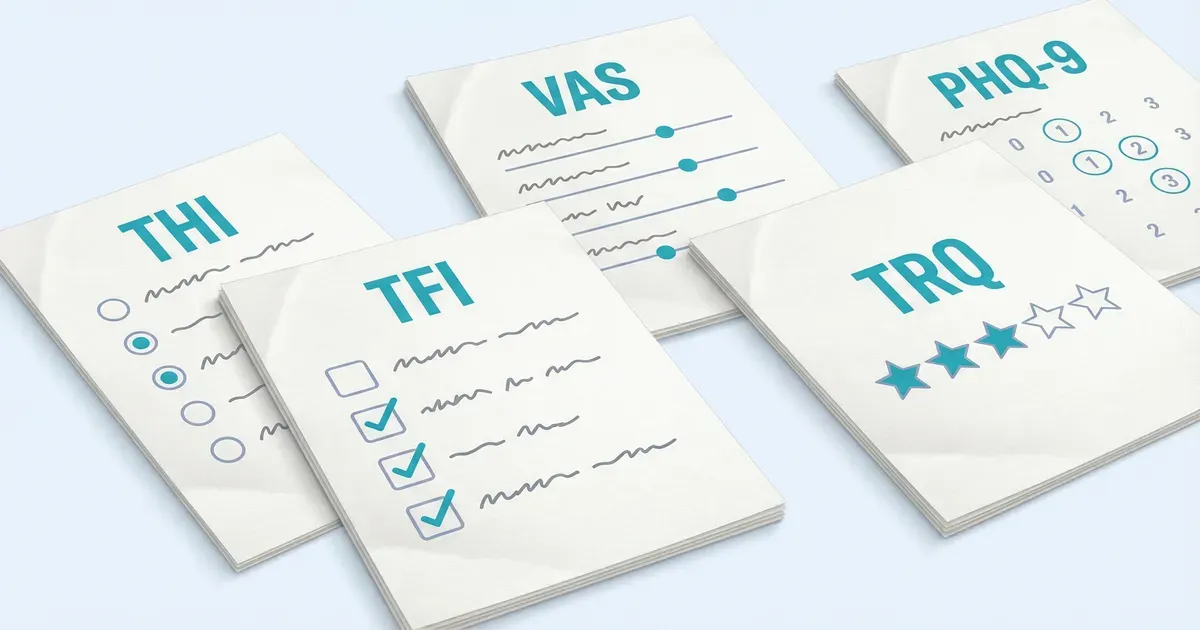
There are quite a few tinnitus assessments available. There are more than a dozen scientifically recognized scales and questionnaires used for subjective (self-reported) assessment of people with tinnitus. We'll list them below, but don't rush to try them all - without a clear understanding of the purpose and specifics of each assessment, it won't be helpful.
In addition, there are various instrumental assessments conducted by neurologists, audiologists, and other specialists: audiograms, hearing tests, and other techniques that evaluate how the auditory system works.
Here is a list of the most well-known questionnaires used for tinnitus:
- (TFI) Tinnitus Functional Index
- (THI) Tinnitus Handicap Inventory
- (ISI) Insomnia Severity Index
- (HQ) Hyperacusis Questionnaire
- (SAD-T) Screening For Anxiety And Depression In Tinnitus
- (TIQ) Tinnitus Impact Questionnaire
- (NIQ) Noise Impact Questionnaire
- 4C Tinnitus Management Questionnaire
For the assessment module in our app, we chose the TFI questionnaire (Tinnitus Functional Index). We find it most suitable for self-guided work on improving tinnitus because it provides a fairly comprehensive assessment of a person's condition. The TFI questionnaire consists of several subscales, each reflecting an important area of a person's life and activity. Here are these subscales:
- Intrusiveness - how often the person notices tinnitus and how intrusive it is
- Sense of control - how much the person feels they can cope with tinnitus and influence their condition
- Cognition - how tinnitus affects concentration, memory, and ability to think and work
- Sleep - how much tinnitus interferes with falling asleep and sleep quality
- Auditory - how tinnitus affects perception of external sounds and communication
- Relaxation - whether tinnitus prevents rest, relaxation, and enjoying quiet
- Quality of life - how much tinnitus limits usual activities and overall sense of life quality
- Emotional distress - level of anxiety, irritability, stress, and other emotional reactions related to tinnitus
Readers who have tinnitus probably recognized in this list the areas of their lives that are (or were) affected by tinnitus. The specially formulated questions of the TFI questionnaire allow you to assess a person's condition both for each area separately and for the overall state. TFI is very well suited for sequential measurements when you're undergoing therapy, doing exercises, or trying different approaches. You take the questionnaire periodically, and the results help you understand how effective your chosen tactics are, as well as confirm your feelings about how your condition has changed. However, you shouldn't take the TFI too often, as any practice needs some time to affect your condition. It's usually done once every three to four weeks or even less frequently - so that changes in condition have time to accumulate and become noticeable on the scale.